Sofia’s housing insecurity
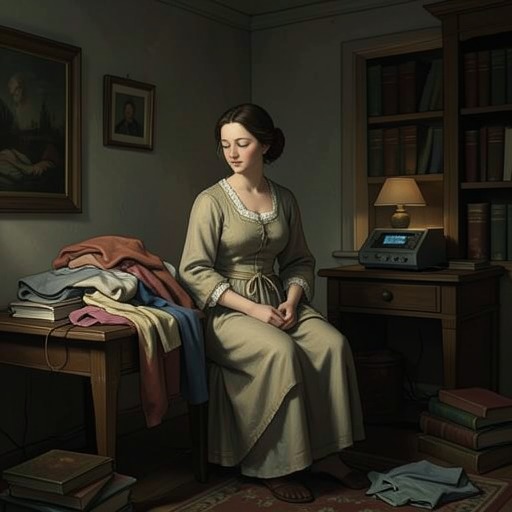
Hot MilkSofia Papastergiadis’s housing insecurity is not simply a lack of a permanent address: it is the condition of having to inhabit other people’s spaces without secure privacy, money, or a clear route elsewhere. The story places her in a storeroom, her mother’s home, and a temporary seaside home in Spain, while care for Rose Papastergiadis narrows her options. Each place offers shelter, but none provides an uncomplicated sense of ownership or independence.
Identity and material conditions
Sofia’s own account of her circumstances is stark: she is always living in someone else’s home. When she speaks with Julieta Gómez, she explains that returning to the temporary beach house in Spain to live with her mother after her medication was cancelled is difficult, but she has nowhere else to go. The temporary nature of the house and the absence of an alternative make her return less a chosen homecoming than a constrained arrangement shaped by Rose’s illness and Sofia’s limited resources.
That constraint extends beyond the time spent in Spain. Sofia tells her father that she sleeps in the storeroom at the Coffee House during the week and at Rose’s on weekends. The split arrangement gives her places to stay, but it does not amount to a home that is hers. She later makes the distinction explicit: she does not even have a home that is not her mother’s. Her circumstances are thus marked both by dependence on Rose and by the lack of an independent domestic base.
A life arranged around other people’s homes
The shifting locations are bound up with Sofia’s responsibilities as Rose’s daughter and caregiver. In one account of their movement through the clinic, Sofia takes Rose’s arm and they limp together, with Sofia matching her pace to her mother’s. She describes her legs as Rose’s legs: their shared pace is a practical accommodation, but it also figures how closely Sofia’s daily life is organized around Rose’s needs. The mother’s home is a place of weekend shelter and care, while the temporary home in Spain makes their shared dependence more immediate.
That accommodation is not constant or straightforward. Sofia sometimes finds herself limping even when she is not walking with Rose, as though her body has retained the pattern of moving at her mother’s pace. The episode links physical memory to the routine of care, rather than presenting their shared movement as a simple, settled arrangement. Her living situation likewise has a bodily and temporal rhythm: weeks divided between the Coffee House and Rose’s home, and an uncertain stay in Spain whose duration depends in part on her sick mother.
The limits of refuge
Sofia’s lack of options becomes particularly concrete in her father’s home. Unable to sleep in a hot spare room with no window or air conditioning, she considers taking her pillow and sheet to the balcony for the cooler air. Her father and his wife are already there, sitting together in deckchairs, and Sofia feels unable to interrupt them or return comfortably to her room. She has nowhere to go and no money for a hotel, even the cheapest room with a window or basic air conditioning. The domestic space is available to her only within other people’s arrangements; even a search for a cooler place to sleep runs up against their presence and her own lack of alternatives.
The storeroom at the Coffee House appears to offer a different kind of refuge because Sofia has made it her own, modestly and provisionally. When Dan from Denver tells her that he has repainted its walls white, she feels that the refurbishment has made the room his. He also asks what should be done with her anthropology textbooks under the bed and her shoes and winter coat hanging behind the door. These belongings mark a lived-in space, but they do not secure her claim to it. The room is her place precisely because she has left traces there; its new paint makes those traces, and her fragile sense of possession, feel vulnerable.
Provisional belonging and unresolved security
Among those traces is the Margaret Mead quotation on the café storeroom wall, which Sofia wrote out with five semicolons used to represent a wink in a text message. That small mark is an act of personal inscription in a room otherwise defined by its practical use as storage. Her textbooks, shoes, coat, and writing make the storeroom recognizably hers in daily life, even as Dan’s repainting exposes how little authority she has over its condition. The tension is not between a home and no shelter at all, but between inhabiting a place and being able to claim it securely.
Sofia’s housing insecurity remains unresolved in the evidence. Her possible length of stay in the temporary seaside home is uncertain, and her week-and-weekend arrangement leaves her without an independent home. Care, money, and access to private space repeatedly determine where she can sleep and how much comfort she can seek. The recurring movement between borrowed rooms and a provisional storeroom gives physical form to her dependence: she can make marks, arrange belongings, and adapt to a space, yet the right to remain there is never fully hers.